
I recently had the pleasure of piloting preeminent photographer and environmentalist, J. Henry Fair, on a little jaunt above the Lowcountry. Henry and I have flown together many times, and he is an avid supporter of SouthWings, where I serve as a volunteer public benefit pilot.
On SouthWings flights, I tell my passengers I am just the bus driver to support their conservation mission. In a nutshell, “Tell me where you want to go, and I’ll head the pointy end of the airplane in that direction.”
When flying with Henry, it’s nigh on impossible to be just a bus driver. Henry is engaging and talkative. His enthusiasm for his work and the causes he espouses is infectious. Even bus drivers get caught up in the mission.
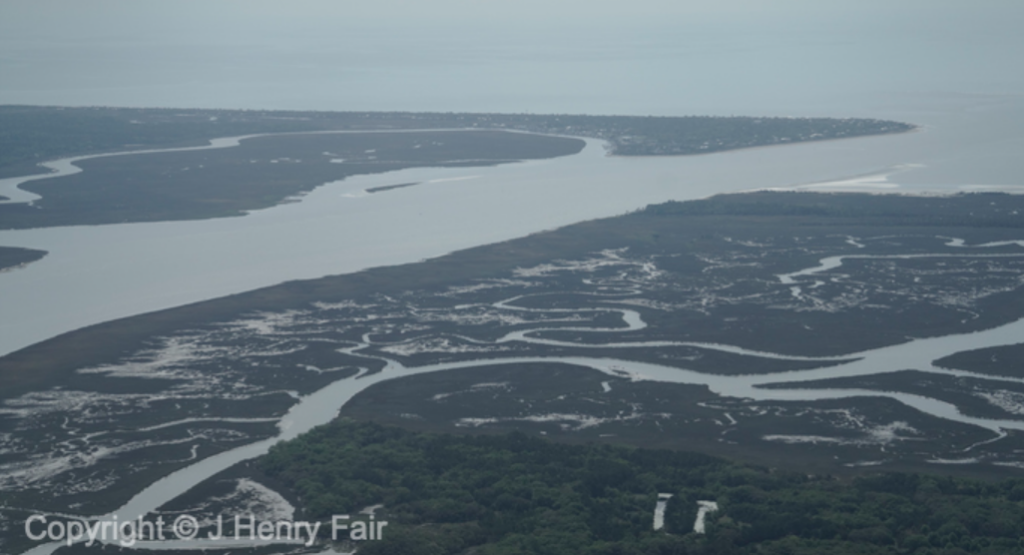
Our recent excursion involved flying from the mouth of the Edisto River, where it flows into the Atlantic Ocean at Edisto Beach, all the way inland to near its headwaters…with one important point of focus along the way.
Photo credit: J. Henry Fair
The Edisto is one of the longest blackwater rivers in North America. It meanders over 250 miles, flowing through some of the most ecologically sensitive land in the Lowcountry. It’s the “E” in the ACE Basin, one of the largest undeveloped wetland ecosystems remaining on the Atlantic Coast. The Edisto also provides a substantial amount of drinking water for the city of Charleston.
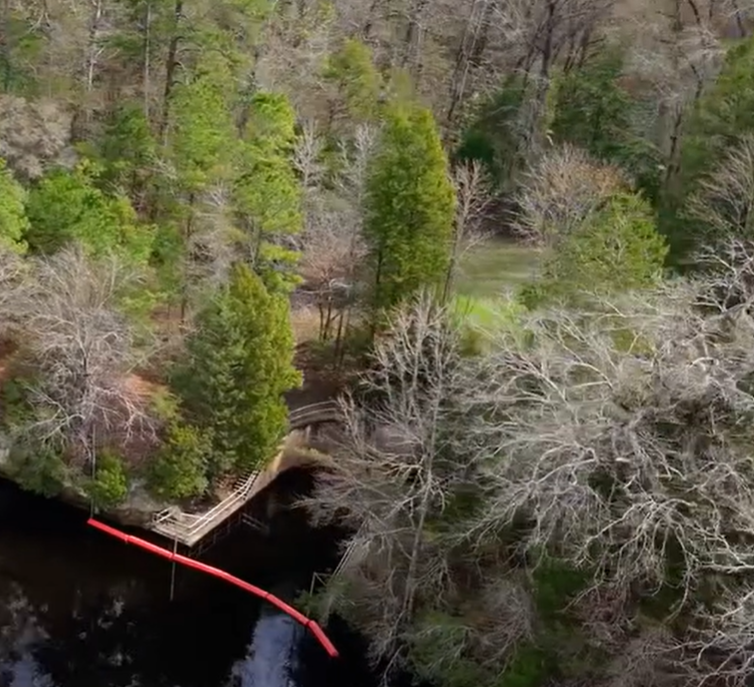
Photo credit: J. Henry Fair
I have kayaked on the Edisto and visited Edisto Island many times. However, I never fully appreciated the river in its entirety until Henry and I made our recent flight. Seeing the full scope of the river from the air gave me a deeper connection to its context and vulnerability. Banking the plane to follow oxbows and watching our shadow skim across reflections of clouds on the ebony black water immersed me in the river’s spirit. The Edisto is a magnificent watershed and a treasure we all should hold dear to our Carolina hearts. For a quick video of in-flight vistas from the cockpit, click here.
As beautiful as the river is, and as much as I’d like to report that it’s all peaches and cream along the Edisto, there are potential environmental problems ahead. Let’s start by graphically showing the situation with a photograph.
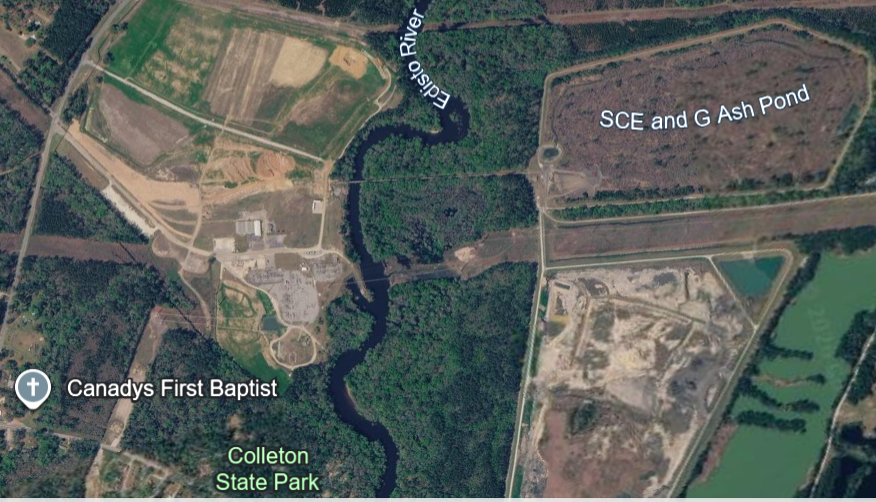
Photo credit: Google Earth
The above picture’s orientation is south-to-north. Our cherished Edisto runs roughly up the center of the photo. The area depicted is in Canadys, SC, central Colleton County. You will note two cleared areas, one on each side of the river. The site on the right is an old coal ash depository. Coal ash has a high propensity for leaching residual toxins, especially arsenic.
The site on the left is the controversial soon-to-be-built Canadys Station electric generating plant. It will be powered by natural gas. The SC Public Service Commission recently approved it in May of this year (2026). The plant’s location is the former site of a dismantled coal-fired generating facility. That’s why there’s a coal ash depository nearby. Fun Fact: Originally estimated to cost $2.5 billion, the new plant is now projected at upwards of $5 billion. And I thought it was just my grocery bill suffering from inflation.
I might also add that the natural gas supply for the eventual power plant will require the construction of a 71-mile pipeline running from Eastern Georgia to the Canadys site. To their credit, the planners tried to avoid some ecologically sensitive land and properties in conservation easements. However, the pipeline will run straight through the pristine Salkehatchie River Basin with all the potential disruption to that important ecosystem. Controversy remains dynamic as landowners and environmental activists push back against the pipeline. NIMBY is alive and well as a local sentiment.
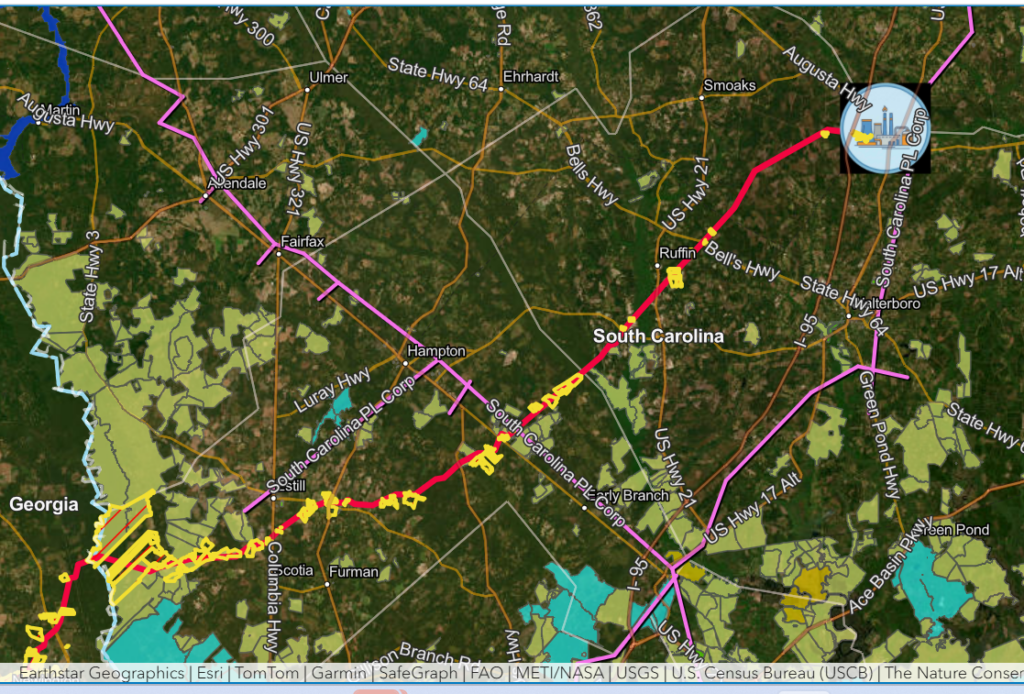
Photo credit: ArcGis.com
The array of issues is complex, but at the core, we all must weigh the burgeoning need for more and economical electricity measured against the impact on sensitive natural settings and ecosystems…and we’re only beginning to assess the impact of data centers requiring massive amounts of clean water in order to operate. I must remind myself that I was just a bus driver on my flight with Henry Fair. All stakeholders in the power plant/pipeline controversy have rational underpinnings to their respective points of view. The trick will be to align disparate views into a balanced policy.
When I looked down on the pristine Edisto flowing between coal ash and impending industrialization, I couldn’t help wondering about the river’s resilience. What will the future bring?
As Henry and I continued our flight northward, the river’s course slowly morphed into a winding ribbon of trees snaking across a verdant landscape. I had time to ponder what I was seeing and marvel at the river’s persistent integrity. Nature has a powerful way of healing itself, despite the hardships we humans impose on it. So, while I look at my electric bill every month and shake my head, this bus driver is rooting for the river!
© 2026 The author does not allow any portion of this work to be used for training artificial intelligence without written permission.