
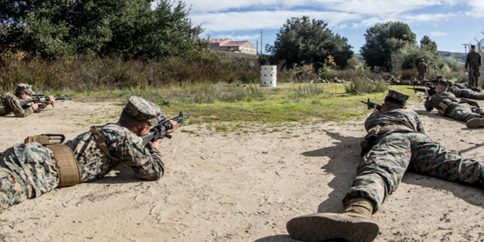
“All ready on the left! All ready on the right! All ready on the firing line. Stand by…targets!”
Anyone who has attended U.S. Marine Corps basic training, either enlisted or officer, will recognize those words from their time on the rifle range. It is the preamble to a firing sequence when recruits shoot for record and earn a shooting badge, either Expert, Sharpshooter, or Marksman. The Marksman badge, lowest on the totem pole, is known “lovingly” as “the toilet seat.”

The first time I heard the distant rattle of rifle fire from the Parris Island range was as a small child. I was in Port Royal with my grandmother, about to get on our boat to go to Hilton Head. Those were the days before there was a bridge to the island, and we lived on Honey Horn Plantation. Thus, we’re talkin’ waaayyy back in the day.
When I heard that distinctive sound, like a burst of rain hitting a tin roof, I was perplexed. “Hey Grandma, what was that?”
“That’s the Marines shooting on the rifle range.”
“What are they shooting at?”
“It’s target practice.”
“What if they hit us?”
“Oh no, honey bun. You don’t have to worry about that. They’re not shooting anywhere near us. You’ll be fine.”
At that moment, at a very young age, I wasn’t so sure. There was a mystery to it all. I had visions of big, tough men in helmets and green dungarees shooting huge rifles, all romping around on a mythical place called Parris Island. It may have actually triggered the subliminal synapse that eventually drew me to becoming a Marine, and ever since that early day, I remain enthralled by the distant sound of rifle fire on the PI range.
Fast forward a couple of decades from that day in Port Royal: I am now a Marine First Lieutenant serving as a series officer on Parris Island. I had chosen PI as my next duty station after my tour in Vietnam because it would bring me back to the Lowcountry. I was under the illusion there would be plenty of free time for hunting and fishing, but recruit training turned out to be quite a full-time occupation, particularly for a series officer.
A series comprises two or three platoons, each starting with about seventy to eighty recruits. There will be some attrition along the way. A recruit platoon is overseen by three or four drill instructors who will steward (a politically correct understatement for what actually happens) the recruits through their transformation from civilian to United States Marine.
Back in the day when I was at PI, about midway through the training cycle, a series would move from their battalion squad bays to the rifle range for two full weeks. The first week was all dry fire, affectionately called “grass week.” That’s when recruits learn the various shooting positions and “snap in” without ammunition. They sit in circles around oil drums painted white with black target images on them. It’s pretty much the same today with multiple variations for different weaponry and tactical requirements. Nonetheless, marksmanship remains central to the Marine ethos, i.e., “Every Marine a rifleman.”
I will never forget when my first series went to live fire. Rather than being on the firing line, i.e., standing with one platoon doing the shooting, I was assigned as the safety officer in the “butts,” i.e., where another platoon was pulling targets up and down for the shooting platoon. It’s perfectly safe because the bullets fly well overhead, and there are deep mounds of dirt piled over concrete to protect everyone. However, having just returned from Vietnam where the snap of bullets flying over one’s head was an angst-inducing sound, the first fusillade startled me so much that I stumbled and fell off the concrete walkway beneath the targets.

I’m sure the recruits were highly amused by a spazzed-out lieutenant taking a header in their company, but I sheepishly dusted myself off and returned to my supervisory post. So much for officer-like military bearing.
So, when you’re out and about in the Lowcountry anywhere near Parris Island, especially near water where sound carries long distances, if you hear that rain-on-a-tin-roof rattle in the distance, it’s another generation of young Marines qualifying with their service rifles. And hopefully, some young lieutenant acting as a safety officer can maintain his or her balance and bearing when the shooting starts
