
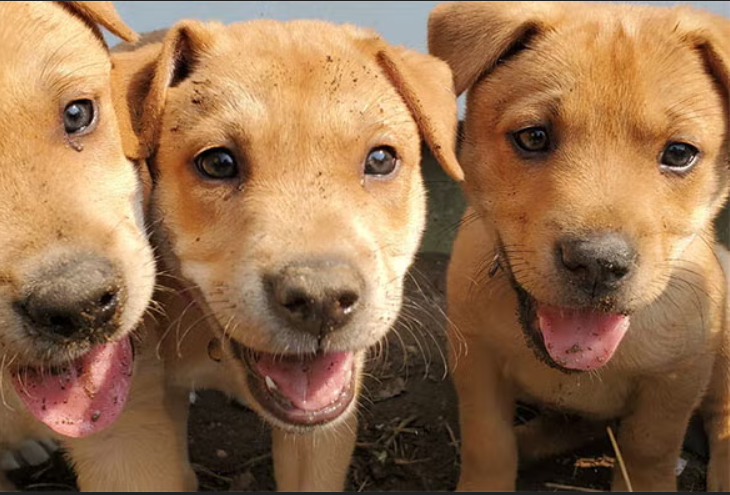
If you’re a writer and you get stuck trying to figure out something to write about, ask a dog. Dogs aren’t necessarily skilled conversationalists, but they are excellent communicators. You’ll know right away if they’re hungry or want their belly rubbed or are having a bad hair day and want a piece of you. I love dogs.
Okay, then, what’s the story. As it turns out, there are two Lowcountry dog stories that come to mind. The first involves my dog, a two-year-old Greater Swiss Mountain Dog named Blue. He is a big goofball, sweet as can be, and he’s convinced he rules the planet.
A few weeks ago, Blue’s mom, namely my beloved wife, Leslie, entered Blue in the canine version of the Chippendale calendar contest. It’s actually known as the Lowcountry Magazine Dog Calendar, and you can read all about it here. OBTW, there’s still time to vote for Blue, who, despite his studly good looks and vibrant personality, is currently languishing in 25th place. Blue couldn’t care less. It’s his mom I’m worried about. 
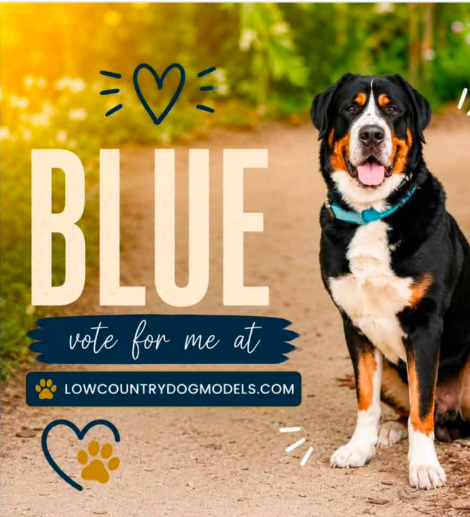
While this may seem like an unabashed plug for my 120-pound puppy’s success as a stud muffin model, it confirms that Lowcountry folk are gaga over their dogs. Rumor has it, the dogs are mostly gaga over food, and they view us humans as a servile resource to indulge their every need. To that I must plead guilty.
As it turns out, dogs have been exploiting their relationship with Lowcountry humans for many thousands of years. It might surprise many of you to know that there’s an actual breed of dog called the Carolina dog. It has several colloquial nicknames, such as “yellow dog,” “yaller dog,” “American dingo,” and “Dixie dingo.”
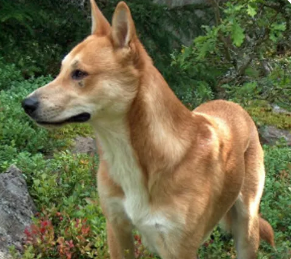
While the word “dingo” might conjure up Elaine Benes’ famous line from the Seinfeld show, “The dingo ate my baby,” the Dixie dingo does not have the nasty streak found in its Australian counterpart. While the two species have physical similarities, DNA evidence suggests they are distinct species.
Carolina dogs are a landrace breed, which means they have adapted to a region and its habitat. Small feral packs of these dogs historically inhabit the longleaf pine forests and cypress swamps of the southeastern U.S., mainly in South Carolina and Georgia.
The breed was “rediscovered” in the 1970s by Dr. I. Lehr Brisbin Jr., a research ecologist who was conducting studies of the 300 square mile isolated wilderness of the Savannah River Plant. He came across a small feral pack and postulated their origin as arriving with migrating indigenous peoples many thousands of years ago.
So how did the dogs get here, and why were they overlooked until relatively recently? The answer to their origin lies with admixture genetics, which ties the wily critters back to species in Eastern Asia. Anyone who has spent time in Asia has seen countless dogs who are spitting images of our dear Dixie dingos.
This would suggest that the original dogs accompanied humans trekking across the Bering Strait land bridge 9-10,000 years ago. The dogs may never have been fully domesticated until recently. They would have simply followed humans around to scavenge the remains of hunting kills and campsite refuse. However, complete Carolina dog skeletons have been found accompanying native peoples’ remains in burial sites, suggesting domestication.
Per various discussions of their behavior today, they tend to be wary and independent until they become accustomed to particular individuals. Once connected, they can be extremely loyal and affectionate, albeit somewhat independent and stubborn.
In recent years, the breed has developed a following. There’s extensive information on Wikipedia here. Two registry organizations, the United Kennel Club (UKC) and the American Rare Breed Association (ARBA), have accepted breed standards, and the American Kennel Club (AKC) has acknowledged the breed. A fun video about Carolina dogs is available on YouTube here.
These cute dogs face endangerment because their populations are declining in both the wild and domesticated ownership. I’m kind of tempted to get one, which will require consultation with Blue, who, of course, rules the roost in our household despite his limited success as a dog model. Dogs are awesome!