
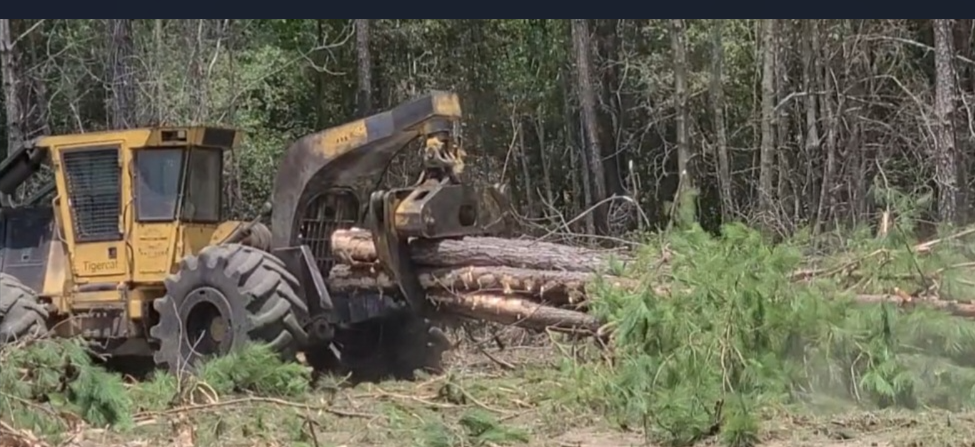
About a week ago, I posted a short video of a logging cut on our land in the South Carolina Lowcountry. It showed a monster piece of equipment called a “buncher” cutting trees at ground level and depositing them in a pile, to be picked up by another monster called a “skidder.” The post went mini-viral with over 4,700 views to date. Followers on my “Lowcountry Writer” Facebook page jumped by almost 1,500. Check out this video [embedded from my Instagram page] to see what started the surge over on Facebook:
With that, I want to welcome all my friends and new followers. You have inspired me to write this blog about timber harvesting, a very important part of Lowcountry life and its economy.
Harvesting timber is an amazing process. The machinery is enormous, loud, and muscular. The operators are highly skilled, and despite the massive size of the equipment, the harvesting process has a choreography worthy of a herd of dancing elephants. A ballet of behemoths, to say the least. However, before the multi-wheeled monsters growl and grumble, there are years of waiting, watching, and nurturing.
Growing timber is not like planting a backyard vegetable garden. With trees, you must think in decades. A planting begins with seedlings, about 650-700 per acre. In the early years, a replant takes some tending because weeds and volunteer scrub plants grow faster than the seedlings. Eventually the trees will grow to sufficient height and density to block out a lot of sunlight, which inhibits much of the understory growth.
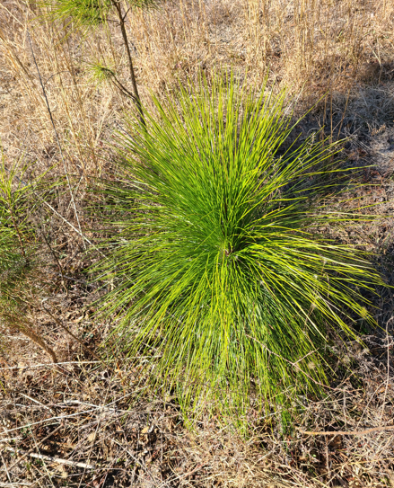
About 12 to 15 years in is about the time for the first thinning cut. This lets some light into the stands of trees and also affords the remaining trees more access to soil nutrients as they grow bigger. Subsequent thinning cuts are based on the ongoing rate of growth and timber market conditions. The last cut will occur 25-30 years after initial planting.
When scheduling trees for harvesting, everything starts with selecting a logging deck. It’s the place where harvested trees come out of the woods to be sorted by size and loaded onto trucks for delivery to the sawmills. Access to an exit road is an essential part of deck placement because the truck loads are massive and can weigh up to 95 tons. The trucks are loaded by timber size, either pulp, chip and saw, saw timber, or “poles.” Poles are just that. They will be treated with a preservative and used for electric and communication transmission lines.
The ballet begins when the bunchers cut trees and lay them down in piles. The above video showed a buncher in action. Here’s a picture of a buncher dropping four cut trees all at once:
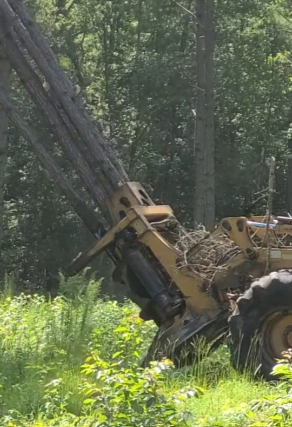
Once the bunchers have laid down a pile of cut timber, the skidders rumble into the woods and grapple up the pile. They drag the cut timber to the logging deck, where it is sorted for eventual transport.
If anyone in the ballet needs a calibrated eyeball, it’s the crane operator at the logging deck. As the skidders bring in the trees, the crane operator runs them through a device that removes branches and tops. Then the crane operator must eyeball the cut trees by size and stack each trunk in the correct pile.
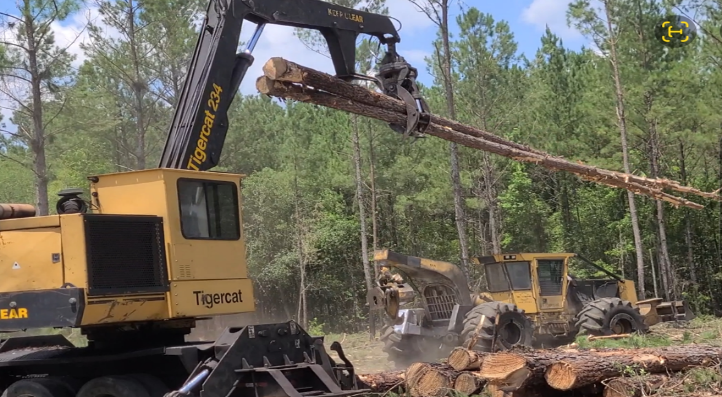
Eventually, the crane operator will hoist the stacked logs onto trucks, which will deliver each load to a specific mill for processing by timber size.
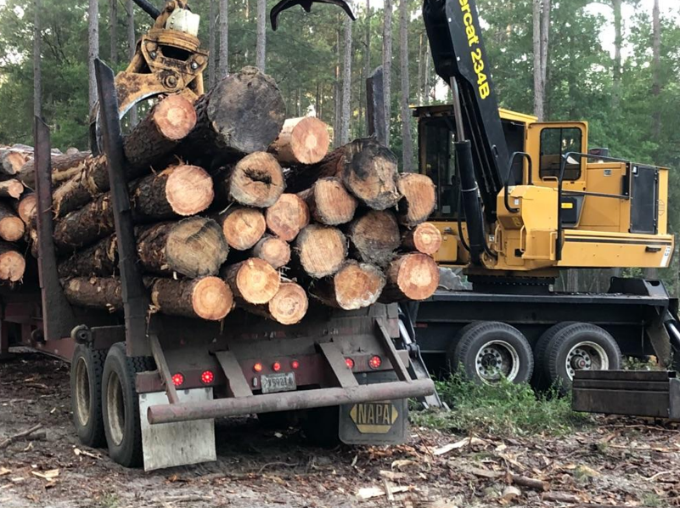
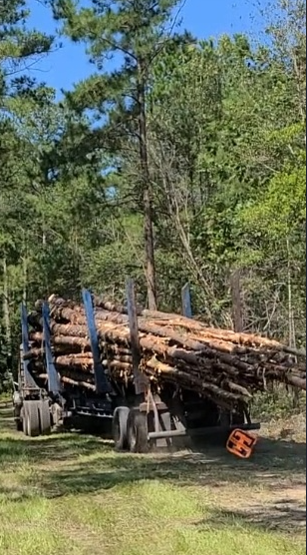
The choreography is enthralling, and a skilled timber team will cut, sort, and haul hundreds of tons in a day. But what happens next?
When the mechanical beasts have gone their merry way, there’s quite a bit of clean-up to do. Forestry is not a gentle business. But it’s fun to wait a while before tidying up the forest. Wildlife loves timber cutting. Machines churning up the ground unearth worms and grubs. There are also lots of crushed, rotted logs and chipped wood, once part of lofty branches, lying on the ground with a variety of bugs still in them. The forest becomes a municipal picnic for foraging birds and animals.
Wildlife critters are innately curious. Big, noisy monsters have rearranged their habitat and, when the chaos settles down, the critters all want to see what’s up in the hood. Let things settle down for a day or two, then find yourself a quiet corner behind some bushes, grab your binoculars, and watch the show. The earth-pawing deer, scampering squirrels, raucous raccoons, and scratching turkeys can be a sight to behold.
When we first started managing timber on our plantation, I realized there was a lot to learn about the business. I signed up for a wonderful program offered by Clemson University’s Agriculture Extension. The curriculum involved remote learning and some field sessions, resulting in certification as a Master Tree Farmer.

Despite the credentials, I continue to learn every day. Schooling was simply a launchpad to a deeper understanding of the Zen of trees and their role in keeping our planet habitable for all life. It’s part science and part spiritual state of mind.
At the plantation, we dedicate ourselves to restoring longleaf pine. Longleaf are the native trees that anchored the ancient habitat of the Lowcountry before European settlers and their descendants cut most of them down. Longleaf grow slower than loblolly and slash pine, the commercial timber of today. The timber industry has been planting loblolly for over a century because of its shorter life cycle to harvest. Longleaf takes patience and a love for the land and its heritage. We’re doing our part to harvest loblolly and restore the regional longleaf forest.
With the felling of the great southern longleaf forests, our country and region lost an important habitat and related ecosystem. This has resulted in survival pressure on species such as the red-cockaded woodpecker, gopher tortoises, and the very cute, if somewhat slow-witted, fox squirrels (see my blog post about those critters here).

This quick overview of timber harvesting in the Lowcountry has only scratched the surface. I view the forests as a treasure. We never cut older trees without a plan for replanting to restore habitat and replenish the important ecological role of trees. While the oceans are the predominant source of oxygen for the planet, trees do their part by providing at least 30% of it. Trees are essential for sustaining terrestrial life throughout the world. And, if nothing else, the beauty of a stately tree will lift one’s spirits and stir the soul.