
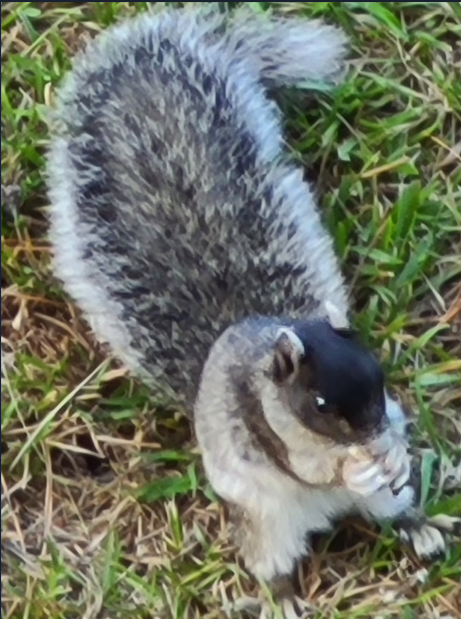
One of my favorite Lowcountry animals is the hapless but adorable fox squirrel. Why, hapless you might ask? They are not endowed by their creator with high IQs, and they like to cavort in open spaces, which makes them vulnerable to avian predators. Also, because of their size, they make a tasty addition to the stewpot for those predisposed to eating squirrels…apparently a significant constituency among rural populations.
A macro-level assessment nationwide shows fox squirrels as not endangered. However, at a more micro level, certain subspecies have been driven to near extinction by things like habitat loss and overhunting. This is particularly true of the southern fox squirrel, a species that once abounded in the Lowcountry and the South.
Our local fox squirrels are habitat sensitive. Loss of longleaf pine forests throughout the South has had a direct impact on fox squirrel populations, as well as many other species such as gopher tortoises, red-cockaded woodpeckers, eastern indigo snakes, a variety of salamanders, and even wild bobwhite quail.
With that background, we as a family made a commitment to do our part in restoring longleaf habitat on our plantation where, among other things, we manage pine stands. When we acquired the property, all the pines were loblolly with not a single longleaf in sight. And, of course, there were no fox squirrels, gopher tortoises, or red-cockaded woodpeckers.
Several years ago, we clear-cut a bunch of the loblolly pines, which provided a perfect opportunity to begin restoration of native habitat. We replanted nearly ten thousand longleaf seedlings…and watched and waited.
For at least a couple of years after planting, longleaf seedlings don’t appear to be growing. They remain in what is called “the grass stage.”

In the grass stage, the saplings put down deep taproots, and they can stay in the grass stage for several years. Happily, most of our seedlings began their upward growth after about two and a half years. It was exciting to see…but no habitat animals showed up until…
In the fall, about three and a half years after planting the seedlings, I was sitting in a deer stand with nothing much going on. I was probably watching a deer hunting video on my cellphone. At a certain point, I looked up and saw something moving about a hundred and fifty yards out in front of me. I dialed in my binoculars, and there it was: an all-black fox squirrel scampering across a patch of grass toward a clump of wax myrtles.
I was so excited I nearly fell out of the deer stand. Our longleaf habitat plan was working. Could red-cockaded woodpeckers, eastern indigo snakes, and gopher tortoises be far behind?
For a few minutes, the fox squirrel was not to be seen. It had darted into the myrtle thicket to do whatever squirrels do: probably scrounging up acorns from the sawtooth oaks lining the edge of the field.
Then, there it was again in a clearing, standing erect on its back legs, looking around like a confused tourist lost in a foreign land. The critter, oblivious to potential danger, began foraging in the grass. It was fun to watch its antics…scamper, scamper, scamper, pick up a seed, stand up with the seed held in both front paws, gnaw the seed, then scamper, scamper, scamper all over again…until…
A red-tailed hawk swooped silently onto a nearby treetop. Uh oh, that didn’t portend a happy ending to my blissful reverie. It’s against the law to shoot red-tailed hawks, but it’s perfectly legal to scare a fox squirrel back into cover by shooting at the ground in its vicinity…except for that awkward low IQ problem.
I shot. The bullet lifted a divot of dust and grass into the air. Instead of running away, the danged squirrel, clearly a slow learner, stood up and looked at me with a quizzical expression as if I was some kind of nut case disturbing the afternoon’s peace and quiet.
Well, you have probably already guessed what happened next. Ricky the red-tail swooped down from the tree, and the first affirmation of our emerging longleaf habitat restoration plan had become a sumptuous supper for a ravenous raptor. That was a bummer of major proportions, but nature is what it is…and a few weeks later a beautiful gray fox squirrel with a black head showed up, apparently blessed with better survival skills than the first one. And soon there were babies and smiles all around.