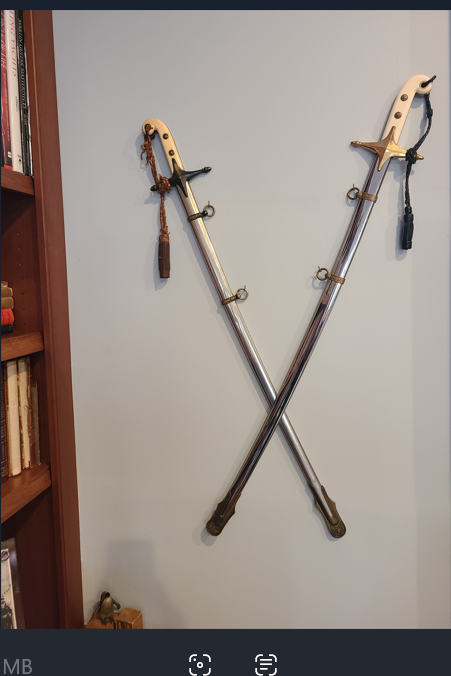

Have you ever had a long-lost family heirloom come back to the family through unexpected circumstances? Or has some possession you’ve given up on finding suddenly appeared without explanation? When it happens, there’s a kind of magic to it all, and it makes you think there might be angels or a gang of happy spirits at work. I’ve had many such instances in my life, so I will tell those stories from time to time under the headline, “Lost and Found in the Lowcountry.”
The first such saga involves a sword, a Marine Corps officer’s sword, vintage 1911 to be exact. It belonged to my maternal grandfather, Colonel David S. Barry Jr., USMC. I never knew or even thought about the sword throughout my life, but that would change when…
The March 2007 edition of Leatherneck Magazine, a monthly publication read by Marines (active and former) all over the world, contained an article about a post-World War I incident in Vladivostok (Siberia). In the winter of 1920, a large Bolshevik ground force threatened to attack and seize the city. Vladivostok was an important coaling station for multiple navies, including the U.S., and the situation had to be stabilized. Here’s an excerpt from the Leatherneck article:

The article included many archive photos, even a picture of Lt Poe. But, alas, there was no picture of my grandfather, the cited Captain David S. Barry Jr. I was intrigued by the story because I had never heard the Vladivostok tale in our family lore. So, I wrote to Leatherneck and sent them a picture of my grandfather as a Lieutenant Colonel in his dress blues taken at my parents’ wedding.

A month or two after I sent the letter, Leatherneck published it along with the photograph. Case closed, everybody happy. But, not so fast, the plot thickened.
In June 2007, I received a letter from a retired Marine Gunnery Sergeant named W. “Lee” Greenfield. The Gunny, a collector of Marine Corps memorabilia, owned a Marine officer’s sword and had long been trying to establish its legacy. He wrote to the magazine, got my address, and informed me he might have my grandfather’s sword. I was stunned, to say the least.
Marine officers treasure their swords. The swords get handed down through the generations or are often buried with the Marine. I wanted to believe Gunny Greenfield, but I wasn’t sure he had found the right person when he located me.
I called my uncle, David S. Barry III, a former Marine in his own right, albeit with a rather checkered career. Uncle Dave retired after six years in the Reserves at the exalted rank of Private First Class…and I’m not sure he ever sewed on his single chevron in the expectation that it would be a short-lived advancement. Despite service setbacks, Uncle Dave was proud of being a Marine, and I would have thought he’d inherited Grandaddy’s sword, or at least have knowledge of its whereabouts. Lo-and-behold, Uncle Dave did not have the sword, and he had no idea what could have happened to it.
Gunny Greenfield sent me some photos of the blade inscription, which clearly showed “D.S. Barry” on the blade. Further, the blade was less ornately engraved than later versions. This established its age in the 1910-1912 vintage, which would have coincided with my grandfather’s commissioning year in 1911.

Could it be? Had someone disposed of Grandaddy’s sword back in the day and had it somehow found its way into the possession of a gracious retired Marine who had cared for it over many years? Apparently so, and I told the Gunny I was very grateful that the sword resided in good hands. And there things sat for almost a year…until…
I received a call from Gunny Greenfield, who told me he was coming to Beaufort for his nephew’s graduation from recruit training at Parris Island. He asked if I wanted to meet him for lunch. I jumped at the chance, and we spent a wonderful hour and a half trading sea stories. Marines love to do that…it’s a cultural thing. We bond by sharing our respective journeys in the Corps.
After lunch, we walked out to the parking lot, promising to stay in touch. It was then that Gunny Greenfield opened the hatchback of his car and handed me the sword. “Here you go, sir. It’s back in the family.”
I was speechless, incapable of even saying “thank you” because of the lump in my throat. I may have actually shed a tear. This was a really big deal, a deeply moving gesture of exceptional generosity.
I pulled myself together and thanked the Gunny profusely. His comment was, “Hey, sir, it was meant to be.” We shook hands and went our separate ways, new friends with an abiding bond.
When I got home with the sword, I spent almost an hour examining every inch. The hilt is real ivory; ivory was legal in those days. The leather accouterments are cordovan brown. In the modern era, they are black. And then there was the truth-teller. I held the sword at “the carry,” which means in my right hand, arm extended straight down at my side. Marine swords are fitted to the individual, and at the carry, the tip of the blade should be parallel to the Marine’s right eye. I am two inches taller than my grandfather was, and the tip of his sword when I held it at the carry was exactly two inches below my right eye. It was an emotional moment to be so physically and spiritually connected to my forebear. I felt the connection in my bones, a sensation that coursed through my body and soul.
Now, two swords, mine and Grandaddy’s, hang crossed together on my library wall. They link a Marine Corps heritage spanning the wars of the twentieth century and affirm a legacy of service, patriotism, and the embodiment of the Marine Corps motto, Semper Fidelis.