
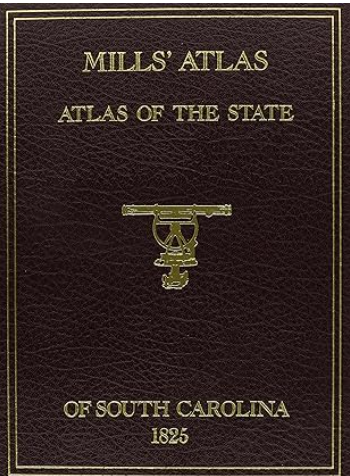
As we approach the 250th anniversary of our nation’s founding, it seems there’s an anniversary for everything. So why not add one more — the 200th anniversary of the publication of the Mills Atlas?
What’s that, you ask? It’s a blast from South Carolina’s past, an extraordinary compilation of district survey maps assembled and published in 1825. Its full name is the Mills Atlas of the State of South Carolina—1825.
As background, starting in 1815, the South Carolina state legislature decided it might be useful to have an official record of the lay of the land. Who wouldn’t want to know that “Colonel Thompson’s Store and Tavern” was just down the road from Chesterville, or you could find “Rock of good quality for millstones” a hop and a skip south of Edgefield. Those are actual annotations and typical info cited on the pages of the atlas.
It was good to know such things, especially if, back in the day, you needed an adult beverage after grinding a few hundred pounds of grits. Thus, the SC legislature commissioned a network of mapmakers to survey the state’s districts, which, back then, preceded counties as the units of governance.
After the surveyors submitted their completed work, Robert Mills reviewed the maps, made revisions, and completed the final compilation. Mills traveled throughout the state and painstakingly reviewed each survey…and might even have bought supplies and hoisted a pint at Colonel Thompson’s Store and Tavern. Mills amended inconsistencies and pulled everything together into one consolidated volume, to which he added a full state map and some noteworthy statistics.
Betcha didn’t know in 1825 the state militia had 40,300 members with 5 major generals, 10 brigadier generals, and 165 colonels, lieutenant colonels, and majors commanding forty-three regiments. There was also a Masonic Lodge denoted on Hilton Head, although I cannot find any information about it. Keep that info handy, and you’ll be a rock star the next time you attend a trivia night.
Original copies of Mills’ publication and the few subsequent reprints are costly and rare. However, the South Carolina state archives can give you a look at the 1938 reprint here for free…although the map sheet annotations are almost impossible to read..
I would love to suggest you hop onto Amazon or eBay and get yourself a copy of the atlas, but even the latter-day reprints have gotten pricey. A used copy of a 1994 reprint is currently offered on Amazon for $361.76. However, with a little poking around, you can often find a reprint of a single district page for about forty bucks. There’s an Etsy page with a copy of the Beaufort District for sale. If you enlarge the page, you can read the old annotations, and you will recognize many familiar place names that were in use two centuries ago.
If you want to get your hands on a full atlas, I suggest starting at your local library. Be sure to bring along a large lens magnifying glass with a built-in light. After all, you’ll be trying to peruse reprints of two-hundred-year-old hand-annotated maps that were barely legible to start with. I’m probably just an incorrigible history nerd, but I love scouring the old maps to compare what was then to what is now.
As the Lowcountry Writer, I am particularly drawn to the maps of the Beaufort and Charleston Districts because together they encompass the bulk of the developed Lowcountry we know today. Of interest to those of you who live in or visit Beaufort County, the Beaufort District of 1825 is now the three counties of Jasper, Beaufort, and Hampton.
Back in 1825, to get to most of the places where we can easily drive today, you needed a boat. There were very few roads, and land transportation was by horseback or on foot. The tides were especially important to river travel because, even if the winds weren’t favorable, the tides would carry a boat up or down the rivers and creeks.

Current-day fishing enthusiasts will recognize renowned creeks where today they can catch direct descendants of fish that lived in our beloved coastal waters in 1825. Pretty cool when you put it all together, and spending some time with the Mills Atlas will connect you to the Lowcountry of long ago.