

As we streak into the holidays, it seems there’s barely enough time to digest the Thanksgiving turkey before we must dispose of the pumpkin décor and start hanging wreaths and installing backlit Santas on our front lawn. It is of course the seasonal tradition, and we all get sucked into the vortex of holiday cheer…and its exhaustion.
In the Lowcountry, there’s another seasonal tradition crammed into the holiday period, and it’s not so well known unless you’re a farmer. It’s the time for harvesting and boiling sugarcane. Most of us who have hung out in the Lowcountry for a while have seen those big, round, rimmed kettle pots folks use for backyard fire pits. They are cast iron and hernia-inducing heavy. Today the kettles sit on patios, many with a hole drilled in the bottom to drain rainwater, a near sacrilege if the pot is an antique. But do you know what the pots were originally used for?
In traditional Lowcountry farm life, the kettles had two primary purposes: scalding hogs and boiling cane juice into syrup…please not at the same time lest you want very sweet pig pickings or some danged nasty cane syrup. There are still a few remaining original kettles in use for boiling cane, which, in local parlance, is called a “cookin’.” I am a proud owner of an original kettle, and we grow and cook cane at our farm in Grays, SC.
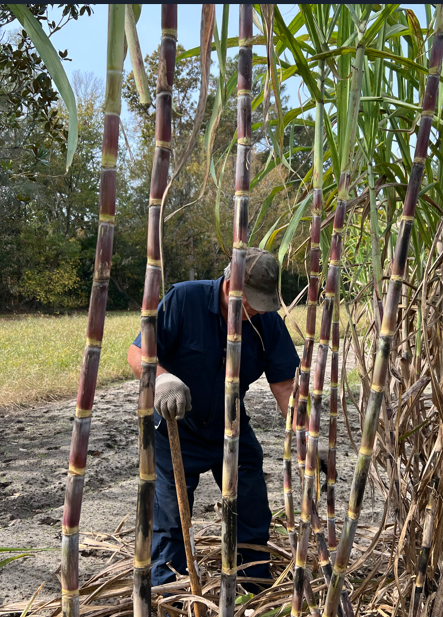
So, what’s the process? Obviously, you must either grow cane or have a source to buy it. The cane is stripped to remove the leaves, cut before the first frost, ground in a mill to extract the juice, and cooked for about four hours until the juice boils down to syrup. Most kettles hold 60 gallons of juice, and a cookin’ produces 7-8 gallons of pure syrup. The whole thing takes a lot of hard work, but there’s joy in it all, and the syrup will put a smile on your face, albeit a sticky one.
Here are a few photos of the sequence of events:


When all is said and done, there’s fun at a cookin’. It usually becomes a local social gathering involving a lot of standing around, eating food, and telling stories about how granddaddy did a cookin’ back in the day. Dogs romp around searching for unattended food plates. Kids await the “candy,” the sweet goo that accumulates on the kettle rim at the end of a boil. Folks excitedly observe “the pour,” and comment on how good the syrup looks, “Ooh, that’s pretty. Looks just like liquid gold. Do y’all think it’ll be as good as last year?”
And with that, the party breaks up, and everyone gets back to the business of Christmas. Meanwhile, the planted cane stalks will lie in the ground, resting until spring, when they will germinate and gather up rainwater to once again deliver their sweet gift for the next year’s cookin’.