
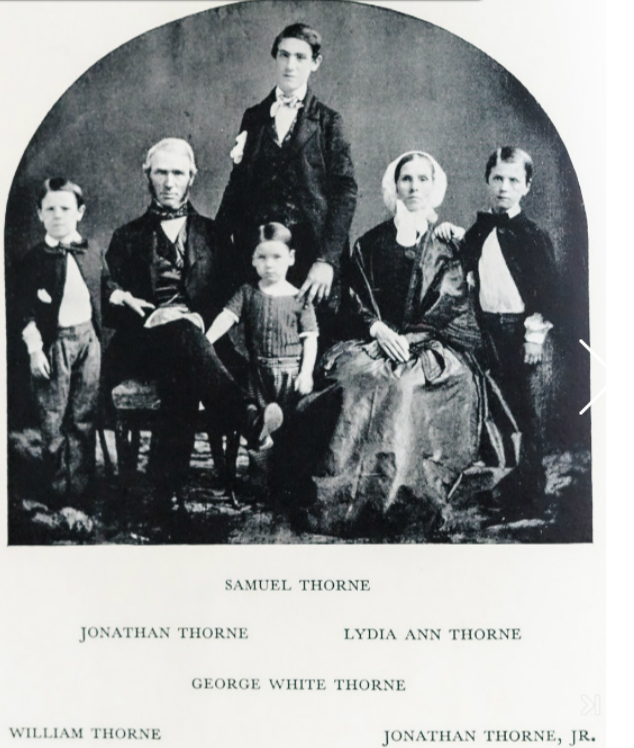
I’m thinking it might be time to introduce y’all to my great-great-grandfather, Samuel Thorne. He was quite a guy, and he left an indelible footprint on our family’s Lowcountry legacy.
Young Samuel came to the Lowcountry for the first time in 1848 at the age of twelve. He accompanied his father, Jonathan Thorne, on a business trip to buy cowhides for the family tanneries in New York. Samuel’s journey was distinctive because he convinced his father to buy him a pony and let him ride it from Charleston all the way back to the family farm in Millbrook, New York…an early hint of the chutzpah Samuel would show throughout his life.
Can you imagine a parent today cutting loose a twelve-year-old with a pony to traverse 900 miles of countryside? In fact, can you envision a twelve-year-old wanting to do it? There’s no USB port on a pony to recharge digital devices…and it would mean being outside all day without SPF 50 sunscreen. Heaven forbid! Clearly, Samuel’s adventure was a failure of responsible parenting.
Today, the social workers would surely show up, and the conversation might go like this: “Excuse me, Mr. Thorne, but we’ve been told your son is missing.”
“No ma’am, he’s fine. He’s on his way to Millbrook on a pony.”
“Where’s Millbrook?” asks the social worker, scribbling madly in a notebook.
“In New York State. Duchess County, to be precise.”
“Do you know where he is now?”
“Not exactly. I’d estimate somewhere near Florence, South Carolina.”
“Don’t you have a child tracker?”
“Yes ma’am. He sends a letter to his mother every third day.”
An audible harrumph is the social worker’s only response.
The cops would soon arrive with an arrest warrant for child neglect. An Amber Alert would surge across the internet, and the Department of Social Services would begin searching for a suitable foster home for young Samuel if he ever turned up.
Things were a tad different in 1848, and young Samuel proceeded on his journey, assiduously keeping a diary and regularly corresponding with his parents. It’s the diary and letters that provide us with a first-hand window into Lowcountry life before the Civil War.
A few background details are necessary. My forebears were devout Quakers, ardently opposed to slavery. Samuel was the oldest of his siblings, some yet unborn. In the culture of the day, as the oldest male heir, he was being groomed to move into the family business. And finally, he was a capable writer, albeit with some spelling oddities and period vernacular… and he always addressed his mom, Lydia Ann Thorne, as “thee.”
With the above background and family portrait for context, I thought I’d drop in an excerpt from a letter Samuel wrote to his mother from Savannah on April 7, 1848. When reading it, please keep in mind he was only twelve years old and wrote the letter almost one hundred and eighty years ago. Some verbiage used back then might be considered controversial today, but it is what it is, and it is unquestionably authentic.
“Dear Mother,
I arrived in Charleston last 3rd day morning about 8 o’clock, I had quite a pleasant passage as all were very kind to me. I was only sea-sick a very short time and that was before I left sight of land. We saw very few vessels during all of our passage. While in Charleston we witnessed a sale of slaves all of which brought $400. They did not appear to care much; probably because they were sold on the condition that they should not be removed from the city. But no matter what the condition; this pratise (sic) of the Southerners is most surely wrong. They do not do as they would be done by; for if they did certainly this abominable practice would be abolished. They would not like to be separated from their parents and their home to be sold into perpetual bondage. But enough of this. Father cannot send thee on any peas yet a while as they are to (sic) dear, being $1 a peck. Strawberries were also wery (sic) scarce and of quite a high price.” (Samuel Thorne)
And there you have it; a pre-teen’s assessment of matters of importance in the bustling town of Charleston, SC, during the spring of 1848.
